
Find where clinic margin and capacity may be leaking.
Aigenrix searches for probable losses in appointment utilization, enquiry conversion, pricing and administrative capacity, tests them against your data, and quantifies only what the evidence supports — before any implementation begins.
30 minutes, free and without obligation. The purpose is to assess whether a Profit Recovery Sprint is justified.
Where clinic value may be lost — mapped to the four categories we test
These are possible diagnostic areas, not guaranteed losses — the Sprint establishes which ones are material in your practice. Each issue is listed once, under the category where the money is lost. Clinical decisions are never part of the analysis.
Margin leakage
- →Treatment prices that no longer reflect practitioner time and consumables
- →Discounts, packages and promotions that erode margin
- →Consumable and supplier costs not passed through to price
- →Services or schedules that contribute little after direct costs
Working-capital inefficiency
- →Deposits and prepayments not collected
- →Delayed billing to insurers or corporate payers
- →Outstanding patient balances
- →Excess or expiring consumable stock
Revenue leakage
- →Enquiries lost to slow or out-of-hours responses
- →No-shows and late cancellations left unfilled
- →Treatment plans proposed but never booked
- →Follow-up and recall appointments that do not happen
Operational inefficiency
- →Front-desk time spent on repetitive scheduling and enquiries
- →Practitioner time spent on documentation
- →Idle room or chair time between appointments
- →Manual re-entry between booking, clinical and billing systems
How each suspected loss is detected and tested
Appointment utilization
- →Booked vs. available practitioner and room hours
- →No-show and late-cancellation rates by service, day and channel
- →Freed slots refilled vs. left empty
- →Trend and variance over time
Enquiry conversion
- →Enquiries by channel and time of day
- →Response time against booking rate, from your own records
- →Enquiries with no follow-up
- →Treatment-plan proposal to booking conversion
Service and practitioner margin
- →Price against practitioner time and consumables per treatment
- →Discount and package usage
- →Contribution by service line and practitioner
- →Consumable cost trend
Administrative capacity
- →Front-desk and documentation time per patient
- →Volume of repetitive enquiries
- →Manual steps between booking, clinical and billing systems
- →Escalations that genuinely require clinical judgment
Data inputs, not software integrations
- →Booking or practice-management system exports
- →Appointment, no-show and cancellation history
- →Enquiry and messaging records by channel
- →Treatment and price lists
- →Consumable and supplier costs
- →Payroll and rota data
- →Invoicing and payment records
- →Insurer or corporate-payer billing, where relevant
These are data inputs the Sprint works from, read from the systems you already run — not new integrations or instrumentation. Patient-identifiable data is not needed for the economic analysis.
Candidate cause chains we test — not conclusions we assume
Enquiries answered only in clinic hours→slow evening and weekend responses→patients book elsewhere→revenue leakage
No confirmation or deposit policy→no-shows left unfilled→idle practitioner time→revenue leakage and operational inefficiency
Prices set once and rarely reviewed→consumable and practitioner costs rise→margin erosion by treatment
Manual re-entry between systems→front-desk time absorbed by admin→less capacity for patients→operational inefficiency
What can happen once a leakage source is confirmed
Not every finding needs the same fix, and not every fix requires AI. The Sprint identifies which mechanism actually applies before recommending one.
How the financial effect is verified
Baseline → intervention → post-intervention measurement → realised financial effect
Identified leakage is an economic opportunity, not a guaranteed result. Realised effect is only confirmed once it is measured against the agreed baseline after implementation.
How the Sprint works for a clinic or healthcare practice
The same Aigenrix methodology applied to your booking, treatment and cost data — not a different product for healthcare. The analysis covers the economics of how the practice runs; clinical decisions stay entirely with clinicians.
Establish the economic baseline
Current financial and operational performance, read from the systems you already run — the reference point every later number is measured against.
Generate and prioritize loss hypotheses
Automated screening of your data, with public and client-provided context, surfaces signals of possible loss. Public information only prioritizes what to investigate; it never establishes a monetary finding by itself.
Request the minimum evidence needed
For each material hypothesis, only the data needed to confirm or reject it — not a blanket data request.
Validate or reject suspected losses
Each hypothesis is tested: some survive, some are rejected, some stay unresolved for lack of evidence — and all three are reported. A benchmark gap can prompt a question; it does not prove a loss.
Quantify defensible exposure and recoverability
Calculate what is provable, estimate what can be defensibly estimated, and separate economic exposure from the expected recoverable range.
Test likely operating causes
Trace each financial symptom to what is causing it in operations, and check that explanation against the evidence — where the data cannot decide between explanations, you see both.
Build intervention economics
For interventions the evidence supports: cost, expected benefit range, payback assumptions, dependencies, risk and confidence. Human review decides where business judgment is required.
Define how realized value will be measured
The baseline, KPIs and measurement period used to report what actually changed after implementation.
Is this a good fit for your practice?
- →Multi-practitioner clinics and practice groups
- →A meaningful volume of enquiries and appointments
- →Booking or practice-management data you can export
- →Management wants measurable economics, not just a new tool
- →The practice can act on findings once they are confirmed
- →Clinical judgment stays with clinicians
Especially relevant when
- →Enquiries arrive faster than the front desk can answer them
- →No-shows or empty slots are frequent
- →Prices have not been reviewed against cost for some time
- →Administrative work grows with every new patient
What a redesigned clinic workflow can look like
An illustrative workflow: agents run reception, intake and follow-up, and your doctors run medicine. The economic effect is measured against your own baseline — never assumed in advance.
Every message answered automatically
Every WhatsApp, Instagram message, call, and email — answered in under two minutes, qualified, and booked. Voice notes get transcribed. Photos get read. Languages get auto-detected. Your team only sees the conversations that actually need a human.

- < 2 minreplies, 24/7, on every channel
- Books, reschedules, confirmswithout a human in the loop
- multilingual out of the box
- Syncs with your calendarbooks straight into CRM
- Trained on your clinic dataadapts to your protocols

Booked, signed, and confirmed before reception even sees it
Every appointment is matched to the right doctor at the right hour — designed to prevent double-bookings and manual copy-paste. The patient signs the procedure-specific consent on their phone with a finger. Cancellations can be refilled from the waitlist automatically. Reschedules happen on WhatsApp, where the patient already is.
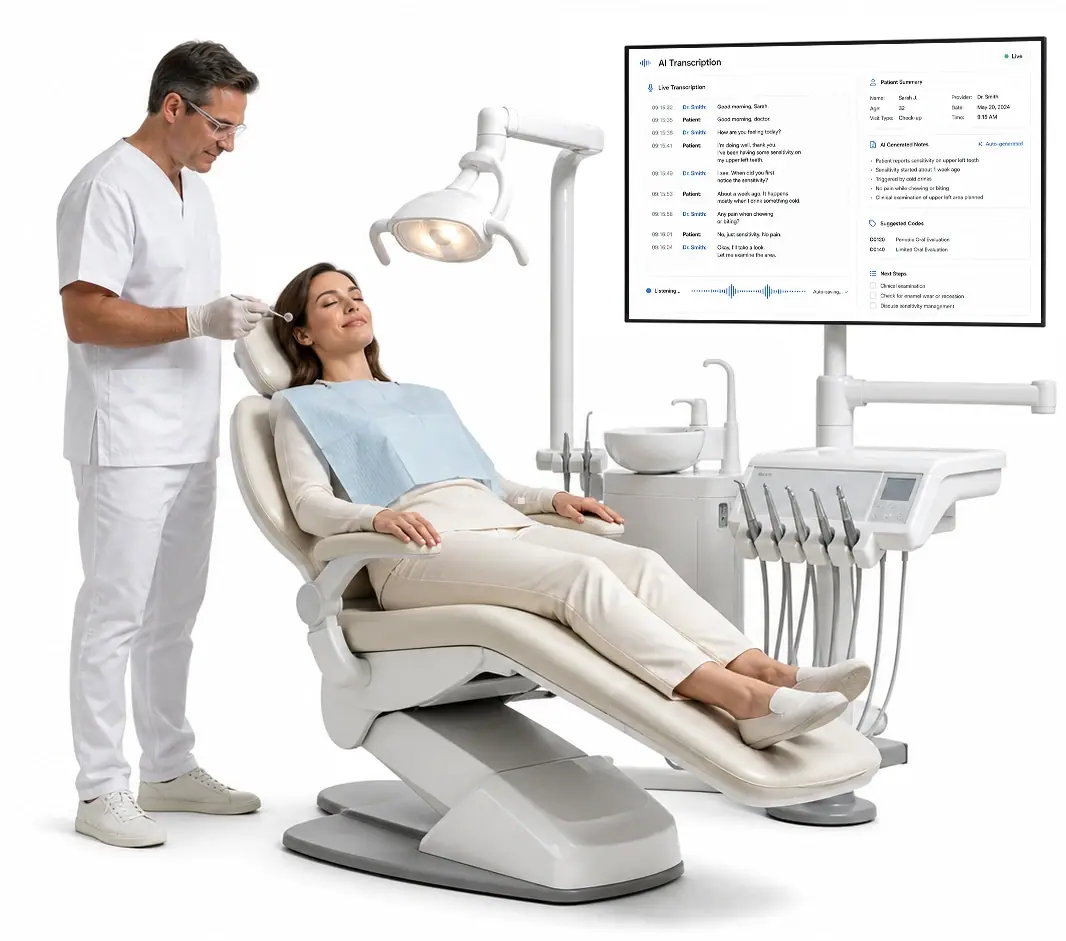
The chart writes itself — while your hands stay on the patient
Mounted next to the chair: a screen the doctor never has to touch. The conversation transcribes itself in the background. Say "add 0.5ml hyaluronic to the chart" and it's added. Say "show me the X-ray from January 2024" and it appears. The patient watches their visit being documented in real time — trust goes up, paperwork stops eating the visit.
Every paper the clinic owes — drafted before the patient leaves
The conversation becomes the chart. The chart becomes the invoice — from what was actually used. The invoice triggers the prescription, the doctor's letter, and the next consent. Every document on your clinic letterhead, signed, compliant — in the patient's inbox before they reach the door.
A published healthcare engagement
Sermed Clinic, a general and aesthetic medicine practice in Barcelona, redesigned first contact and booking. The released reception capacity was observed; its financial value is modelled, not measured as cash.
One engagement — it shows the method, not an expected result for other practices.
Find out whether clinic leakage is material in your practice
A Profit Recovery Sprint tests the most material suspected losses, quantifies what the evidence supports, and builds the investment case where action is justified — before any implementation commitment.
30 minutes, free and without obligation. The purpose is to assess whether a Profit Recovery Sprint is justified.
Prefer email? team@aigenrix.com